
Infrastructure-Scale Renewable Power for Energy Security and Long-Term Resilience
Somewhere above the last power line, there is a mountainside that catches the sun almost every day of the year. It already owns the one thing the world’s most ambitious solar-tower projects spend fortunes trying to erect: height. HOVAK Energy is built on a simple conviction — the mountain is the power plant. It is only missing the machinery.
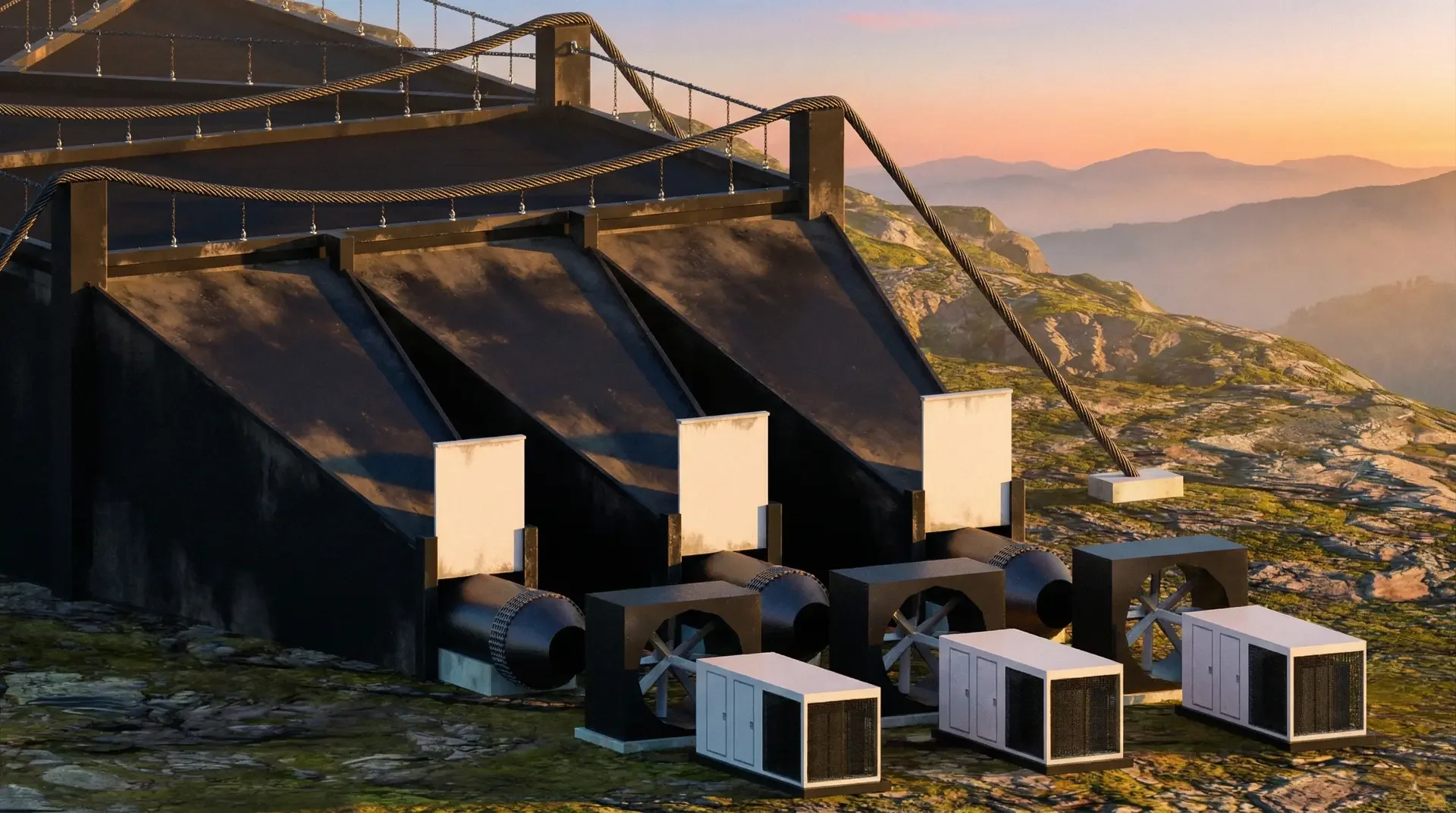
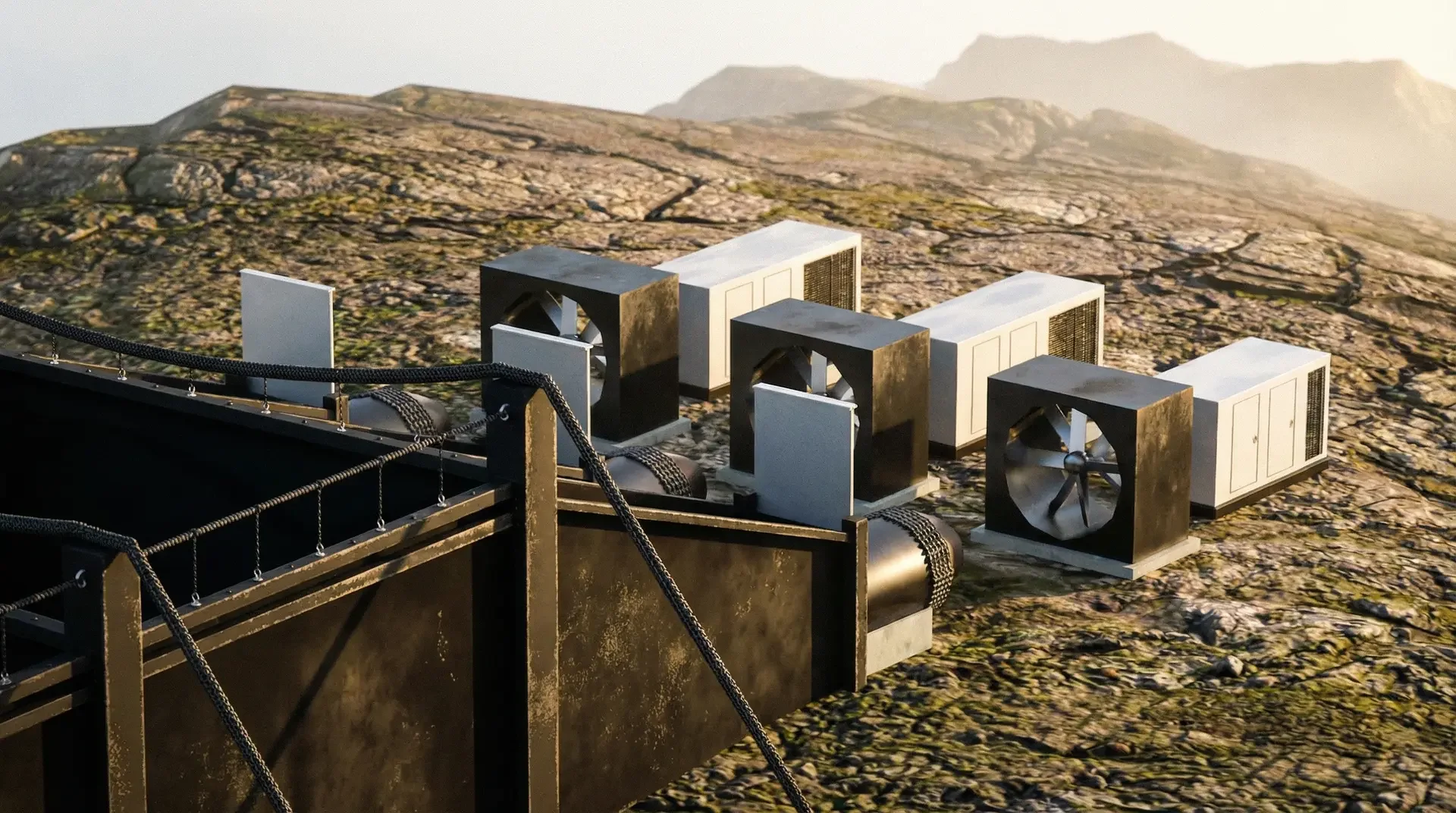
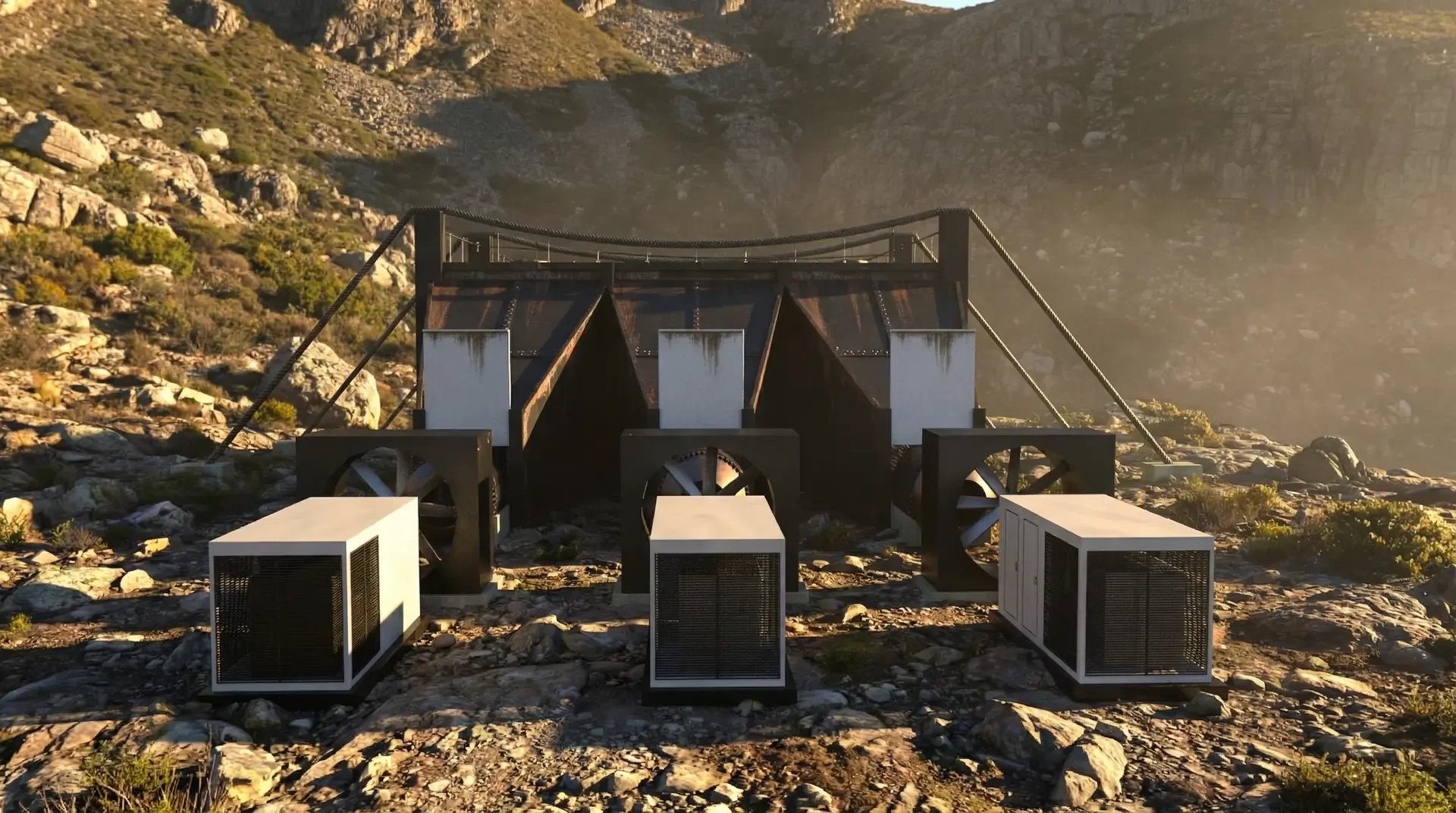
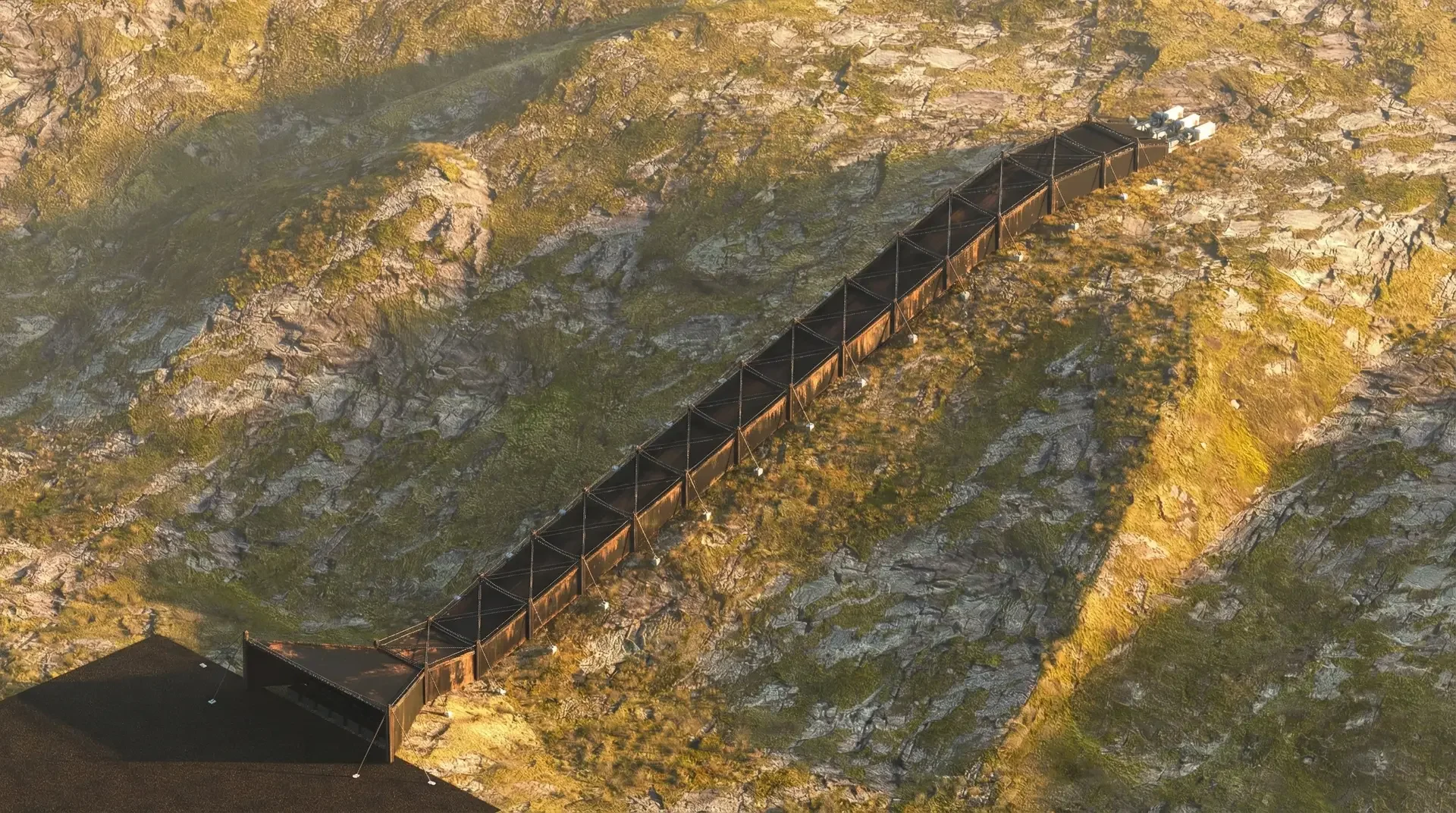
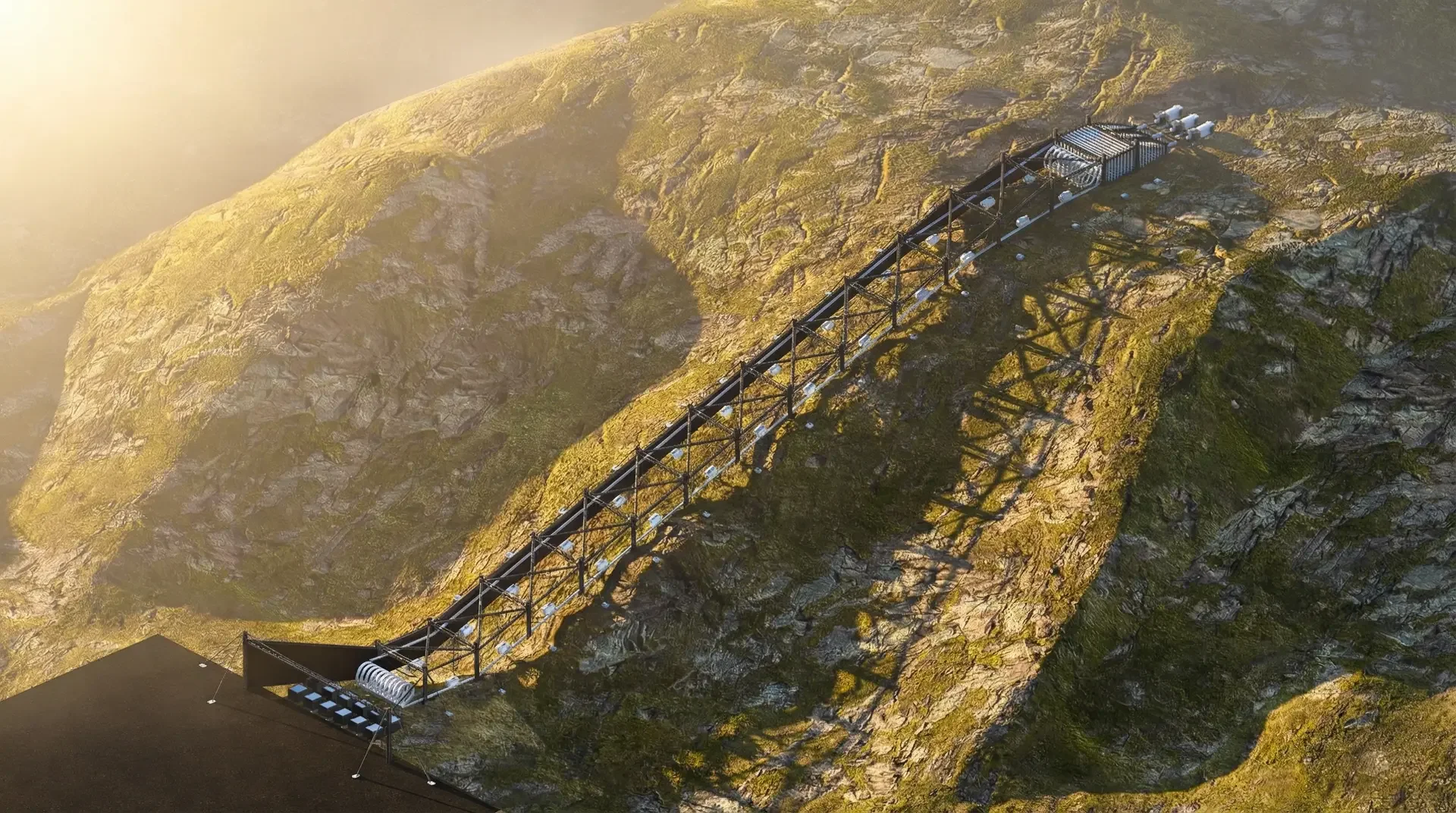
HOVAK Energy is developing a next-generation renewable infrastructure platform for regions where energy affordability, grid stability, and long-term independence are strategic priorities. Our core concept, the Solar Compression Power Station, converts solar heat and terrain-driven airflow into practical electrical output through proven industrial components — a solar-heated channel running up a natural slope, feeding standard turbo-generator equipment. No freestanding tower. No fields of glass. The terrain does the structural work, and what remains to be built is the inexpensive part.
This is an infrastructure-first approach: engineered for difficult geographies, long service life, phased implementation, and measurable public-value outcomes. HOVAK Energy is designed to operate in the real world — under budget constraints, terrain limitations, and long planning horizons — not as a laboratory demonstration that ends when the funding does.
The Strategic Context
Global energy risk is increasingly driven by three forces: import dependence, price volatility, and climate stress on infrastructure that was never designed for it. The regions that feel these forces first — mountainous, remote, sitting at the thin end of the grid — are usually the last to be offered a solution.
Conventional pathways can be effective, but each arrives with a familiar constraint: high upfront capital, long deployment timelines, complex operations and maintenance, or a poor fit for steep terrain. Wind needs wind. Hydro needs a river. Solar farms need flat land that mountain communities rarely have to spare.
HOVAK Energy addresses this gap with a terrain-adapted renewable architecture focused on:
practical deployment logic that works where roads are thin and budgets are thinner,
reliability across the entire lifecycle, not just the first decade,
reduced maintenance intensity, built from components local engineers already understand,
and financing structures compatible with both development funding and private capital.
The platform is positioned not as a replacement for other generation technologies, but as a high-value addition to national and regional energy portfolios wherever topography and sunshine line up in its favor.
Technology Approach (High-Level, Non-Confidential)
The underlying physics is old, proven, and almost disarmingly simple: heat air, and it rises. A pilot plant in Manzanares, Spain, demonstrated solar updraft generation as far back as the 1980s. What kept the idea from spreading was never the physics — it was the tower: hundreds of meters of freestanding, wind-loaded construction whose cost consumed the economics before the first kilowatt was ever produced.
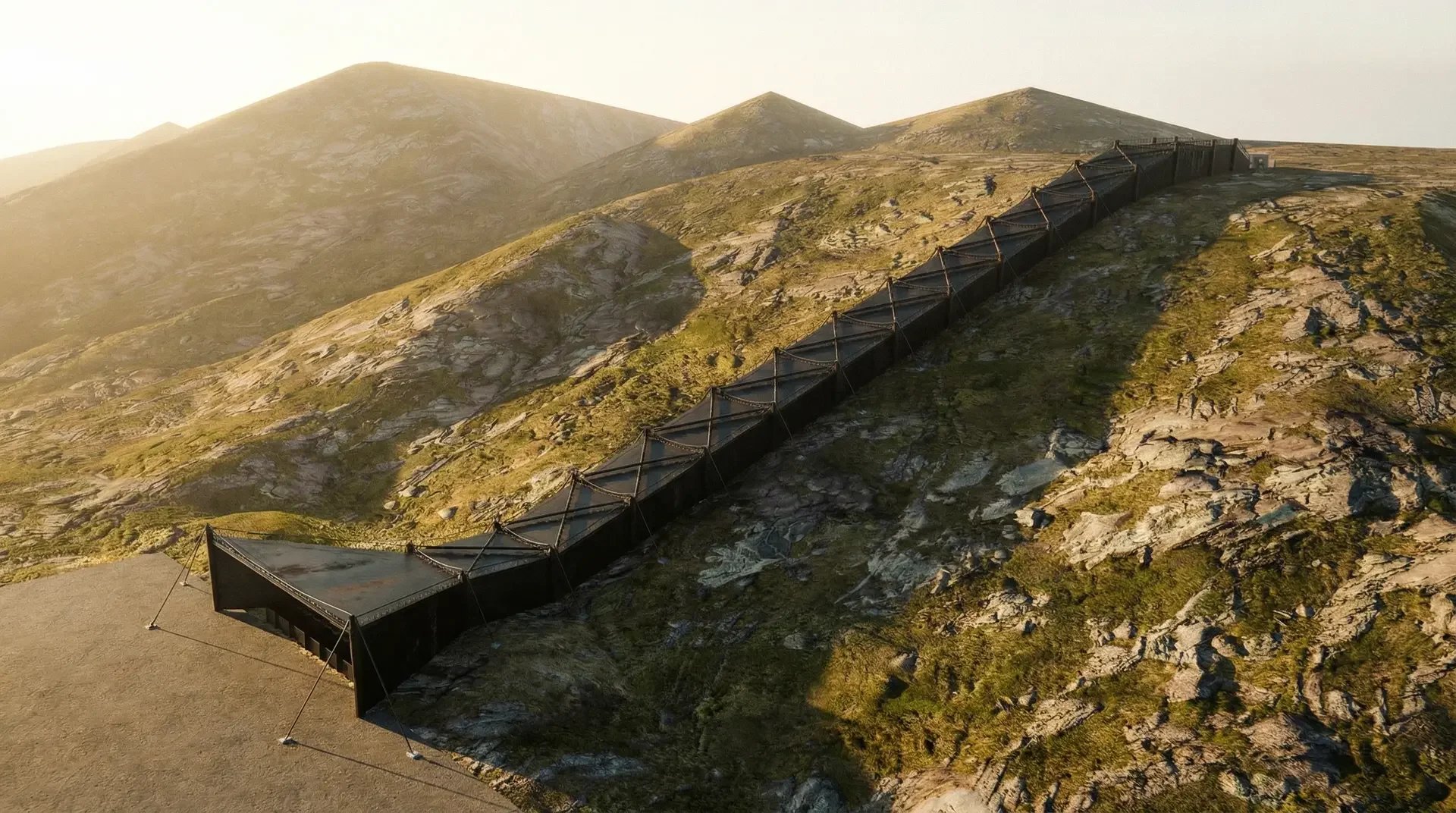
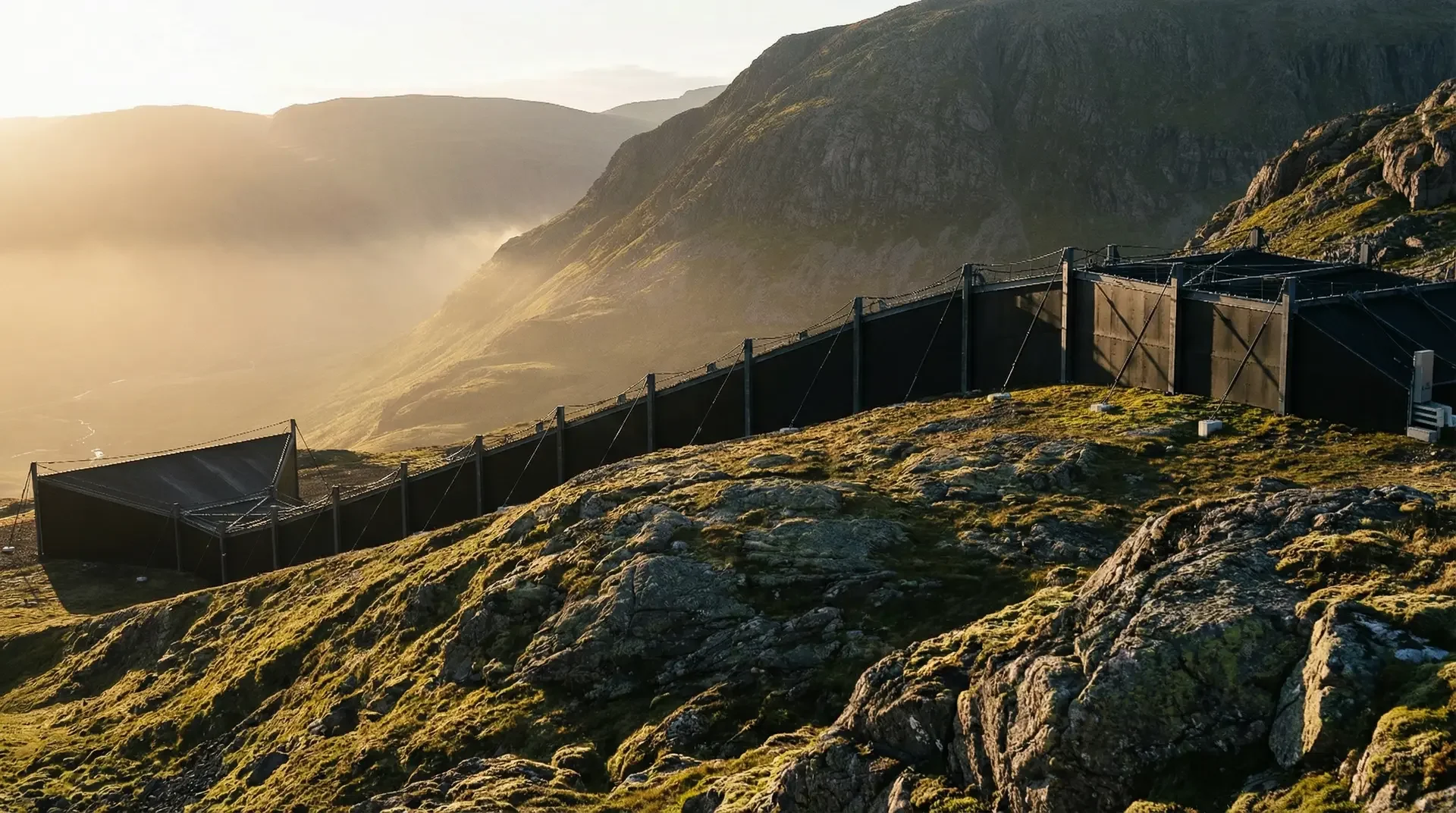
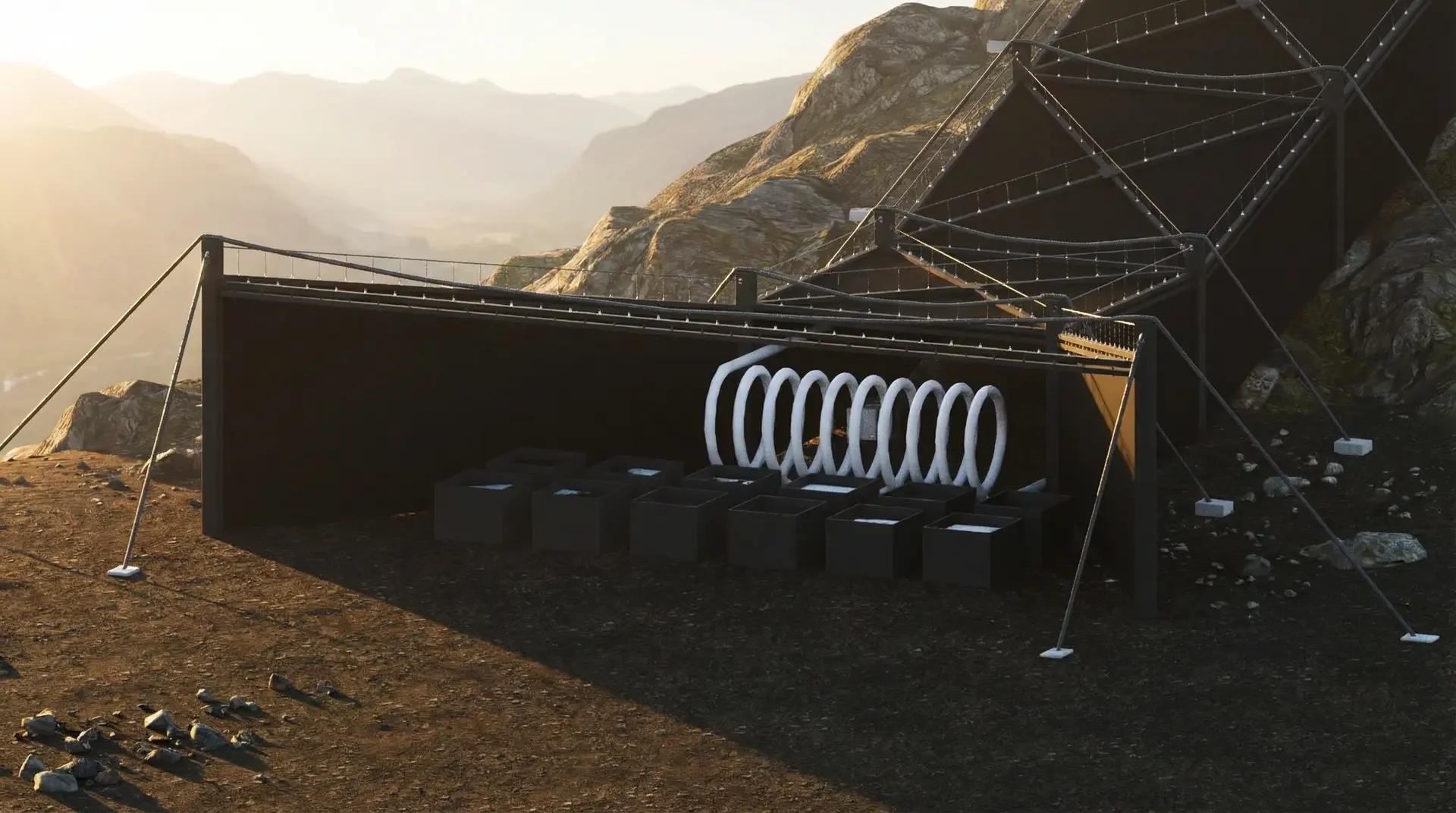
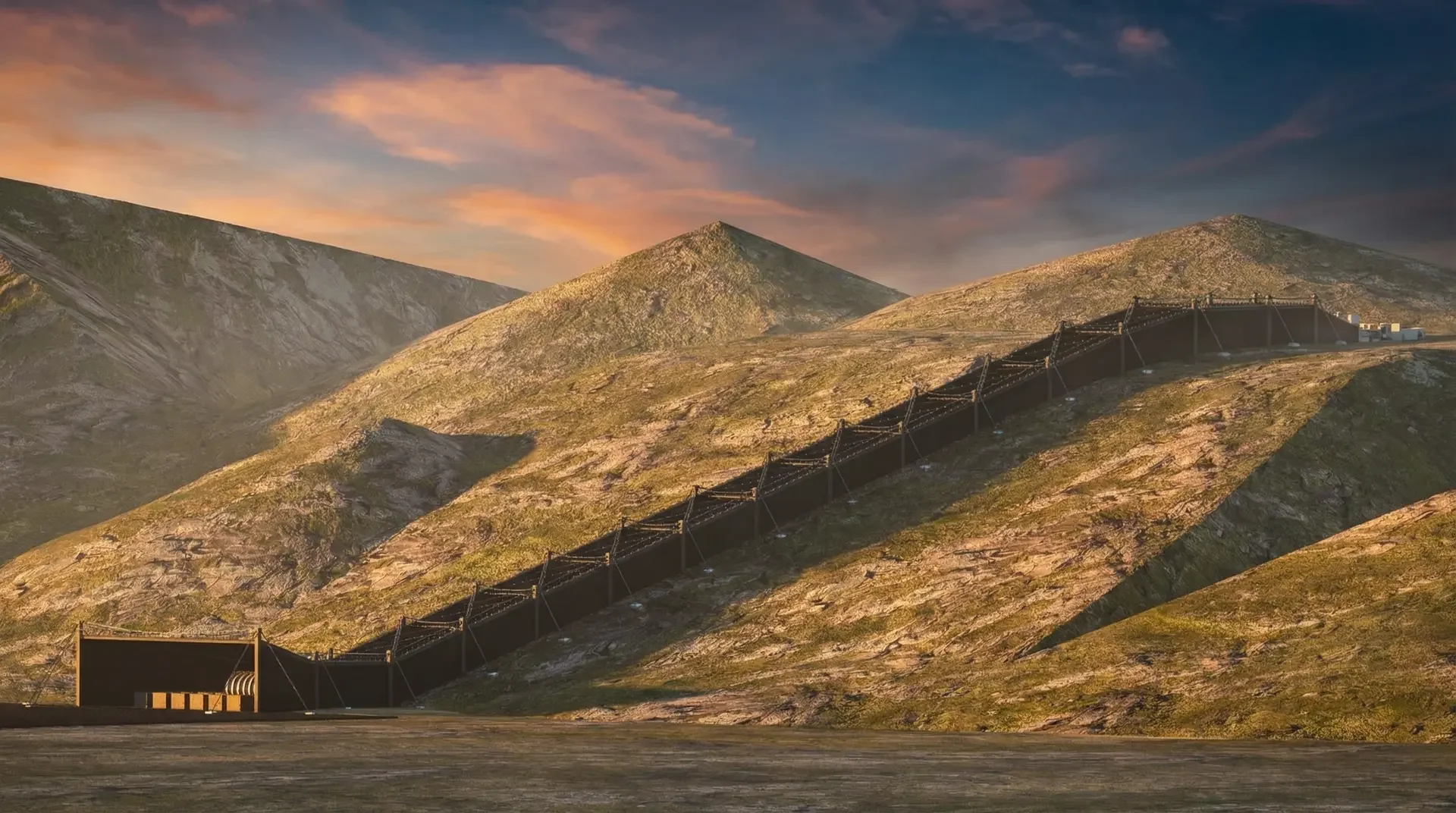
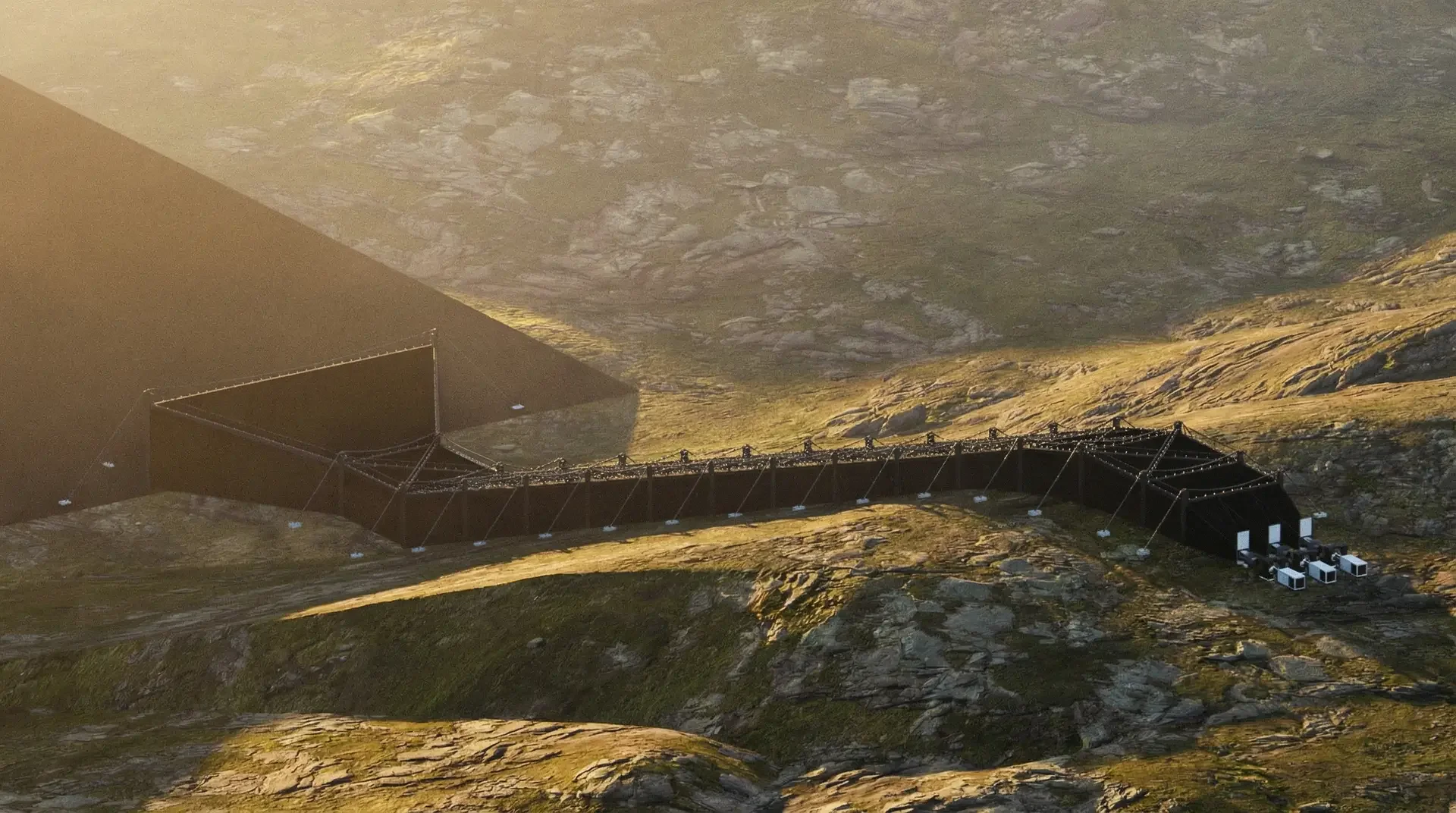
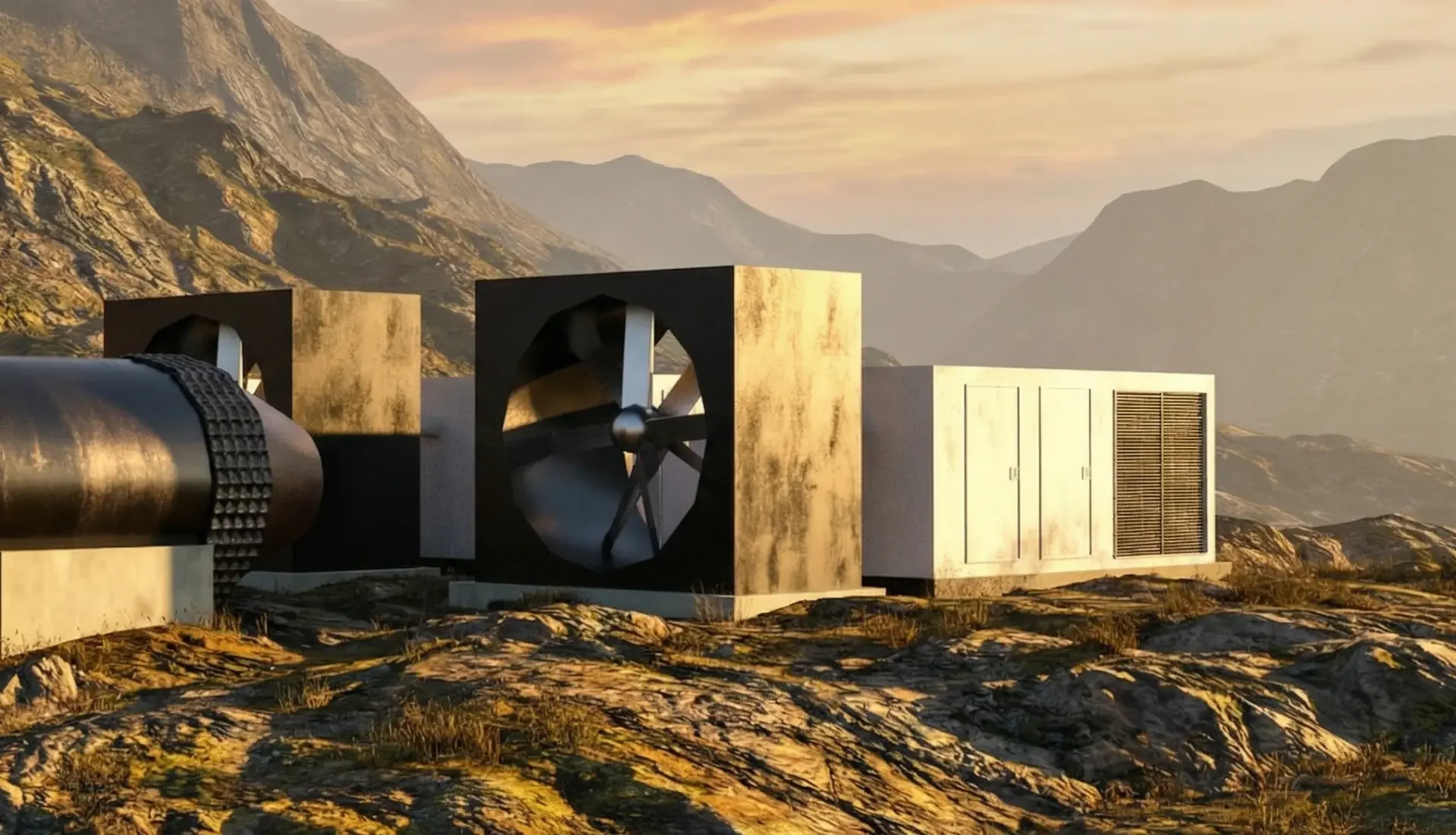
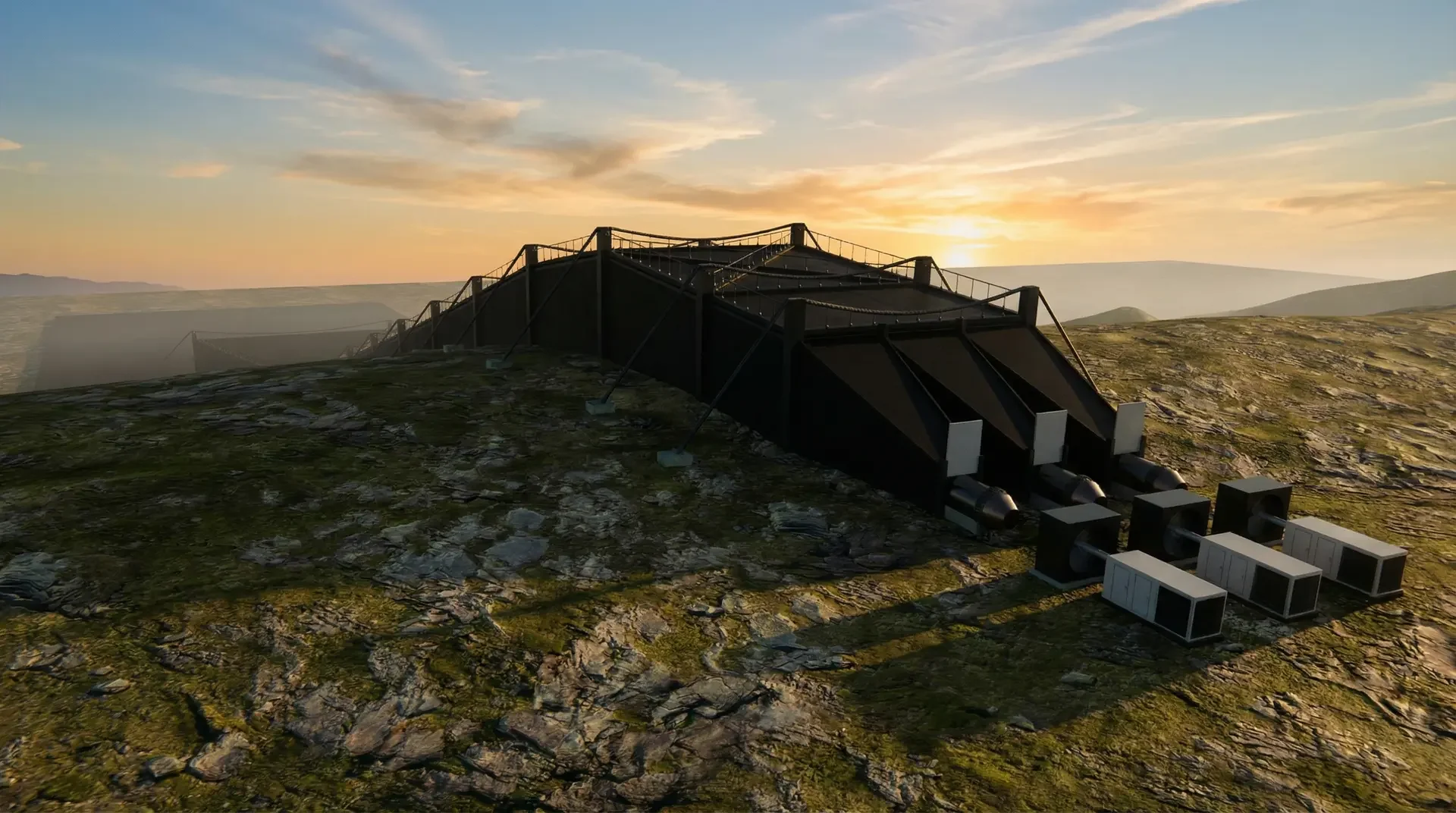
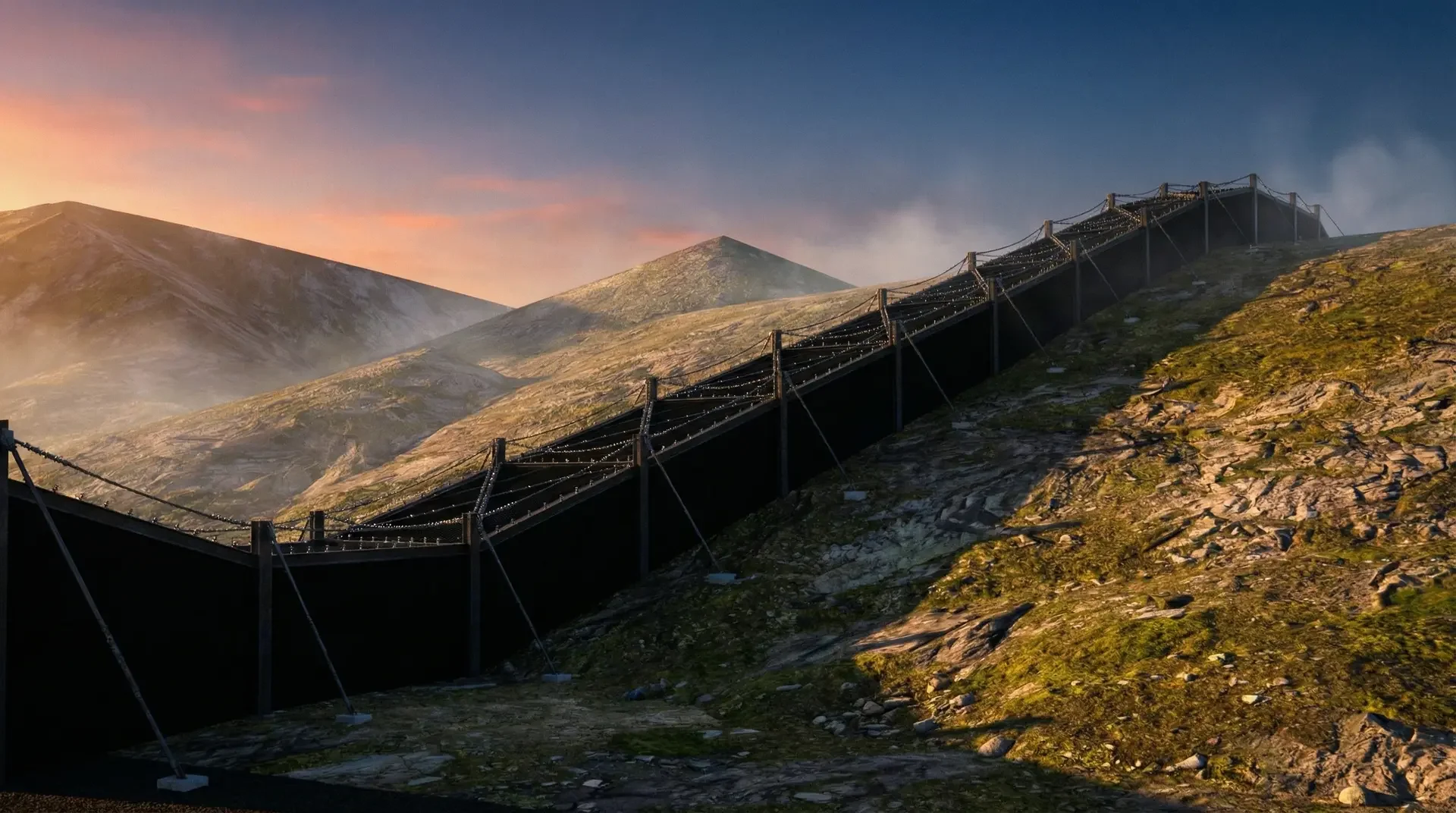
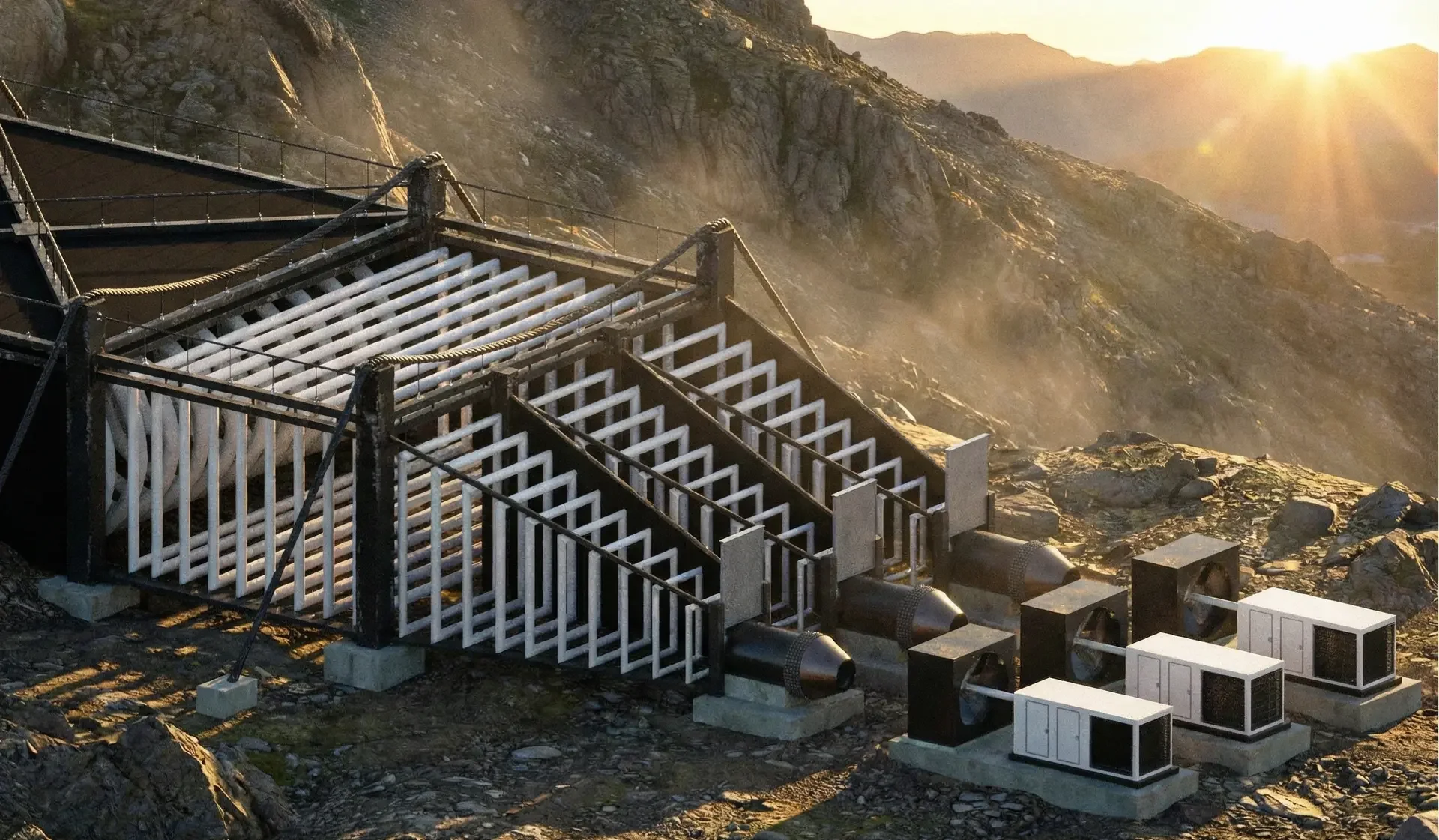
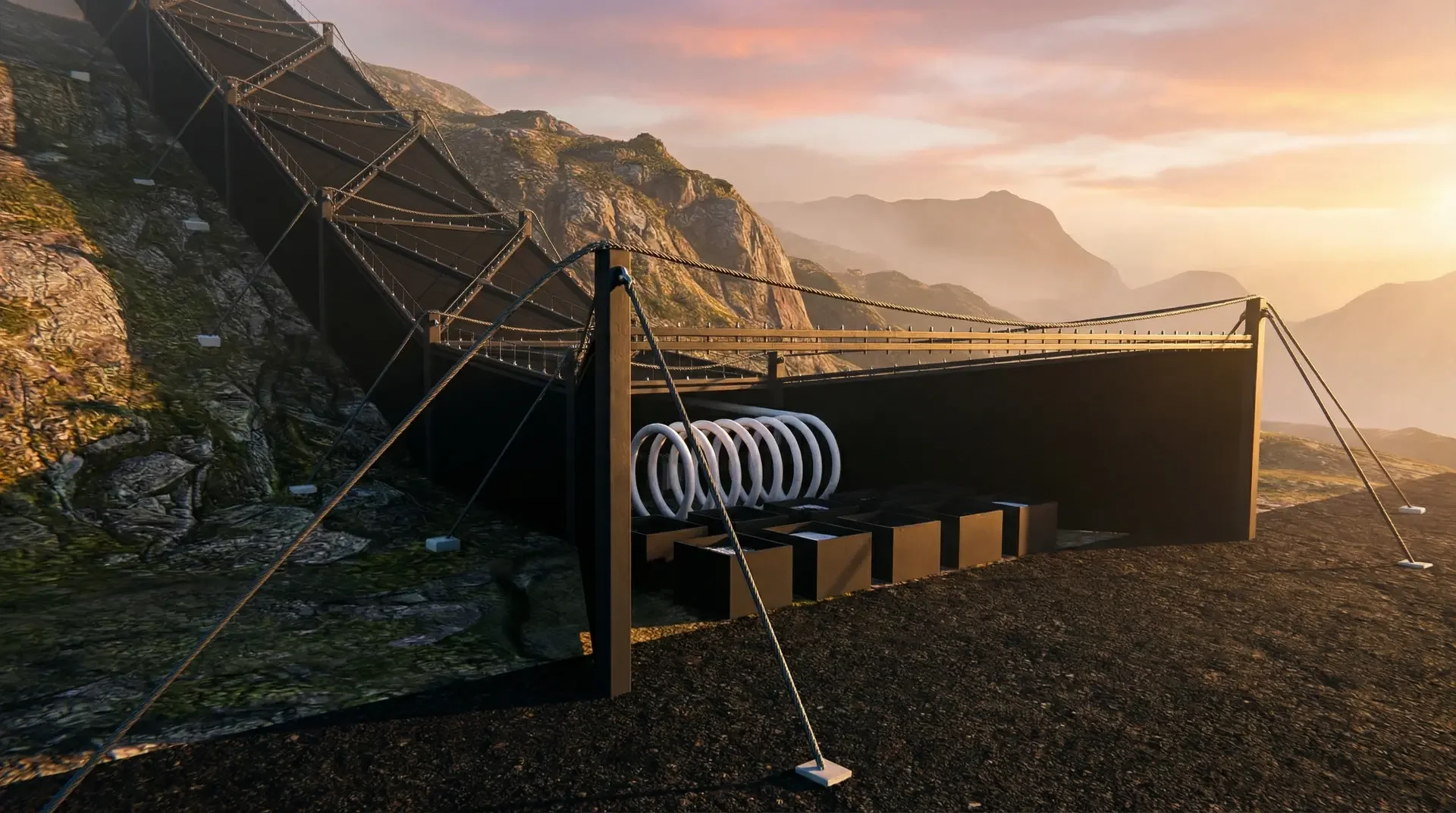
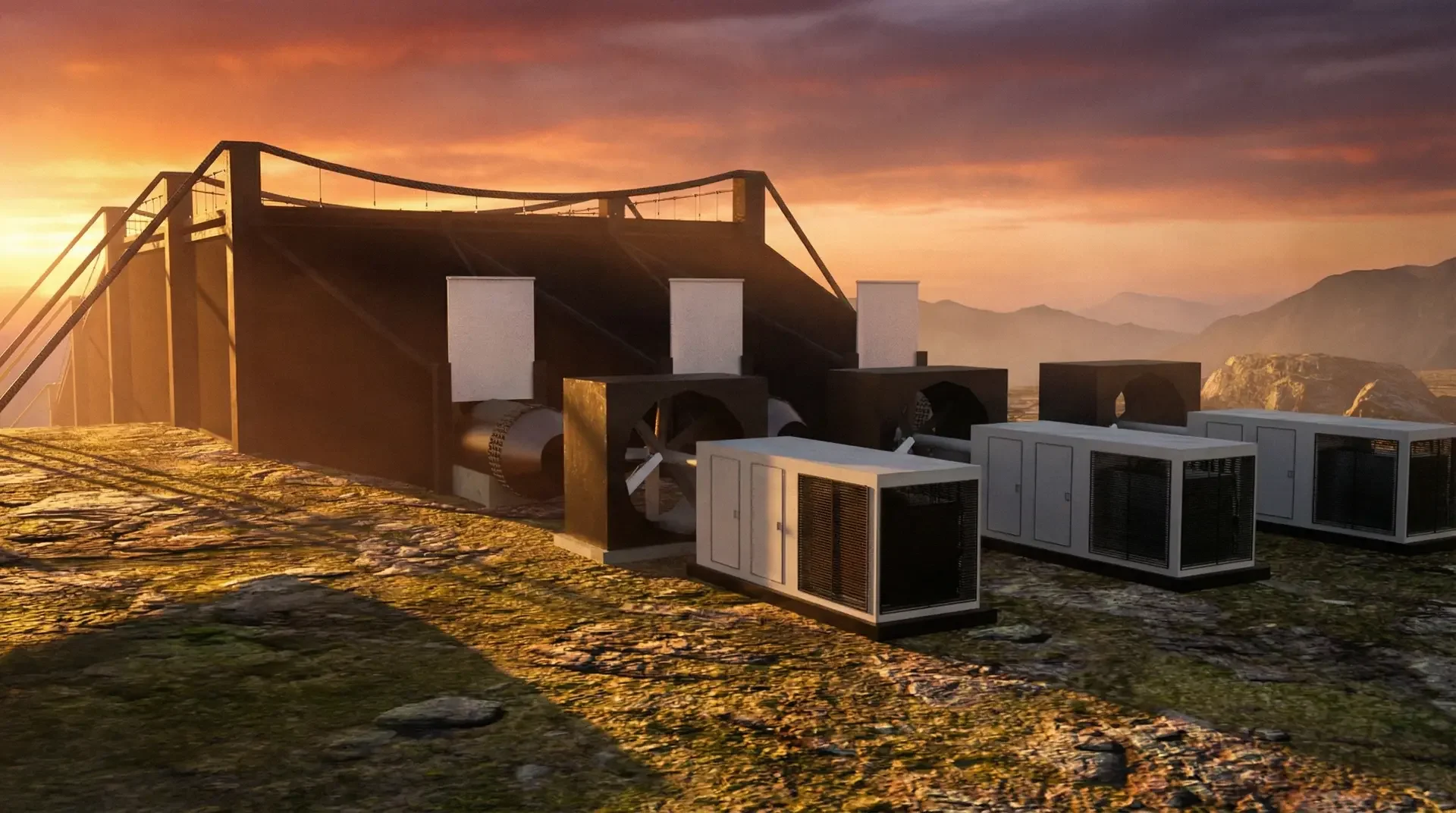
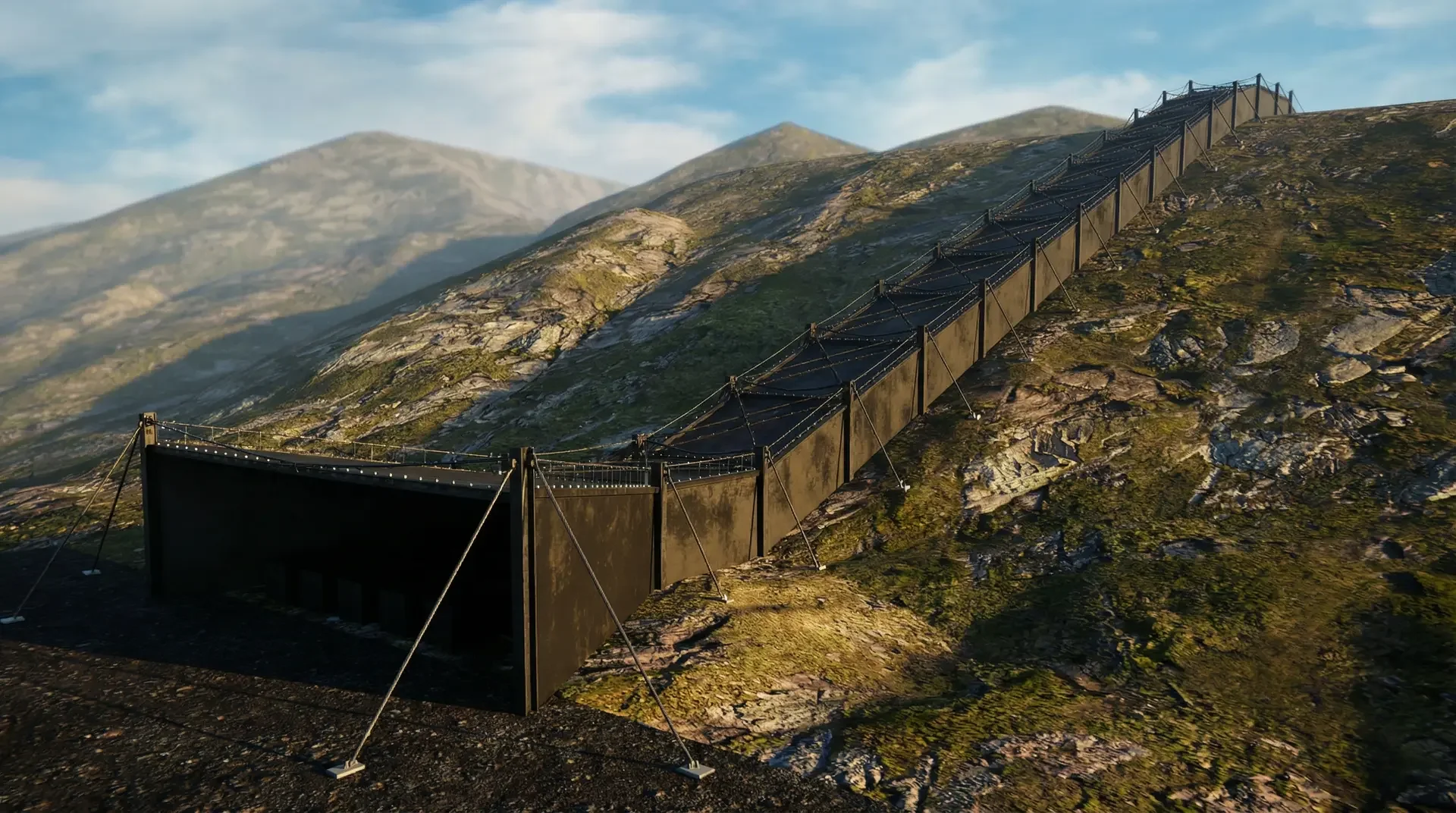
The Solar Compression Power Station takes the tower out of the equation. A dark, heat-absorbing channel is laid along an ordinary mountain slope; the sun keeps heating the air inside it along the entire climb; a controlled pressure-gradient mechanism — the “compression” in the station’s name — accelerates that airflow into industrially familiar generation equipment near the summit. The elevation that classical designs had to construct, the terrain supplies for free, at scales no built structure could match.
That is the public, non-confidential logic of the system. The proprietary layer — geometry optimization, site-specific engineering methods, and performance-control configurations — remains protected and is disclosed only through controlled technical channels (NDA, due-diligence data room, scoped engineering engagement). This disclosure strategy keeps institutions and investors fully informed while preserving the project’s core intellectual advantage.
Implementation Architecture
HOVAK Energy follows a staged infrastructure pathway:
Site Qualification & Baseline Modeling — geo-terrain screening, climate profile, infrastructure access, and integration scenarios.
Pilot Engineering & Validation — site-specific optimization, metering framework, operating-envelope definition, and performance verification.
Phased Construction & Early Commissioning — a sequential build-out designed to start delivering electricity before the full installation is complete, where technically and regulatorily feasible.
Scale-Up & Integration — expansion into utility, industrial, or hybrid energy use cases with long-term operational planning.
Each stage exists to de-risk the one after it. The model improves capital discipline, aligns naturally with milestone-based grant and blended-finance structures, and asks no one to fund stage four before stage one has proven itself.
Preliminary Engineering-Economic Benchmarks
(Model-based; site-dependent; subject to pilot validation and final engineering.)
Current internal benchmarks and project materials indicate:
Installed-capacity construction cost (model range): USD 300–600 per kW
Modeled payback range: 1–6 years
Design service life target: up to ~100 years
Reference construction horizon: ~1 year (configuration-dependent)
Potential early electricity during phased build-out, where conditions allow
One of these numbers deserves a pause: the service life. Solar panels degrade and are typically replaced within 20–25 years. A station made of steel channel and standard industrial turbines is engineered infrastructure — closer to a bridge than to a gadget — and it is designed to be inherited, not replaced.
These figures are not universal guarantees. They are preliminary engineering-economic indicators that must be confirmed against local terrain, meteorological data, permitting realities, grid conditions, supply-chain pricing, and pilot-stage performance evidence. The framing is deliberate: we would rather publish a defensible range than an impressive fiction — a discipline that preserves credibility with development institutions while keeping the project investable for commercial partners.
Commercial Relevance
For infrastructure investors and private partners, HOVAK Energy offers a clear commercial thesis:
Capex efficiency potential under suitable site conditions — the single most expensive element of classical solar-updraft designs, the tower, is simply absent;
long-lifecycle asset orientation — a century-scale asset maintained with standard industrial components;
phased deployment logic that reduces early capital burden and can produce revenue signals before full build-out;
and a technology posture built on practical engineering rather than black-box dependency.
Potential commercial application domains include:
grid-support generation in terrain-suitable regions,
industrial power for energy-intensive remote operations,
distributed infrastructure for resilience-oriented portfolios,
public-private infrastructure programs with long-duration utility objectives.
Development and Grant Relevance
For grant agencies, climate funds, and public institutions, the same platform reads in a different but equally strong language:
energy security and reduced import vulnerability,
climate-adaptive infrastructure design,
regional resilience in remote and mountainous areas,
long-term public-value assets that outlive their financing by decades,
and implementation pathways that support milestone-based governance.
HOVAK Energy can therefore be structured within development frameworks as a staged impact project with measurable technical, economic, and institutional outputs — and with a benefit that needs no translation for the people it serves: dependable light and power in places the grid has long treated as an afterthought.

Origins and Recognition
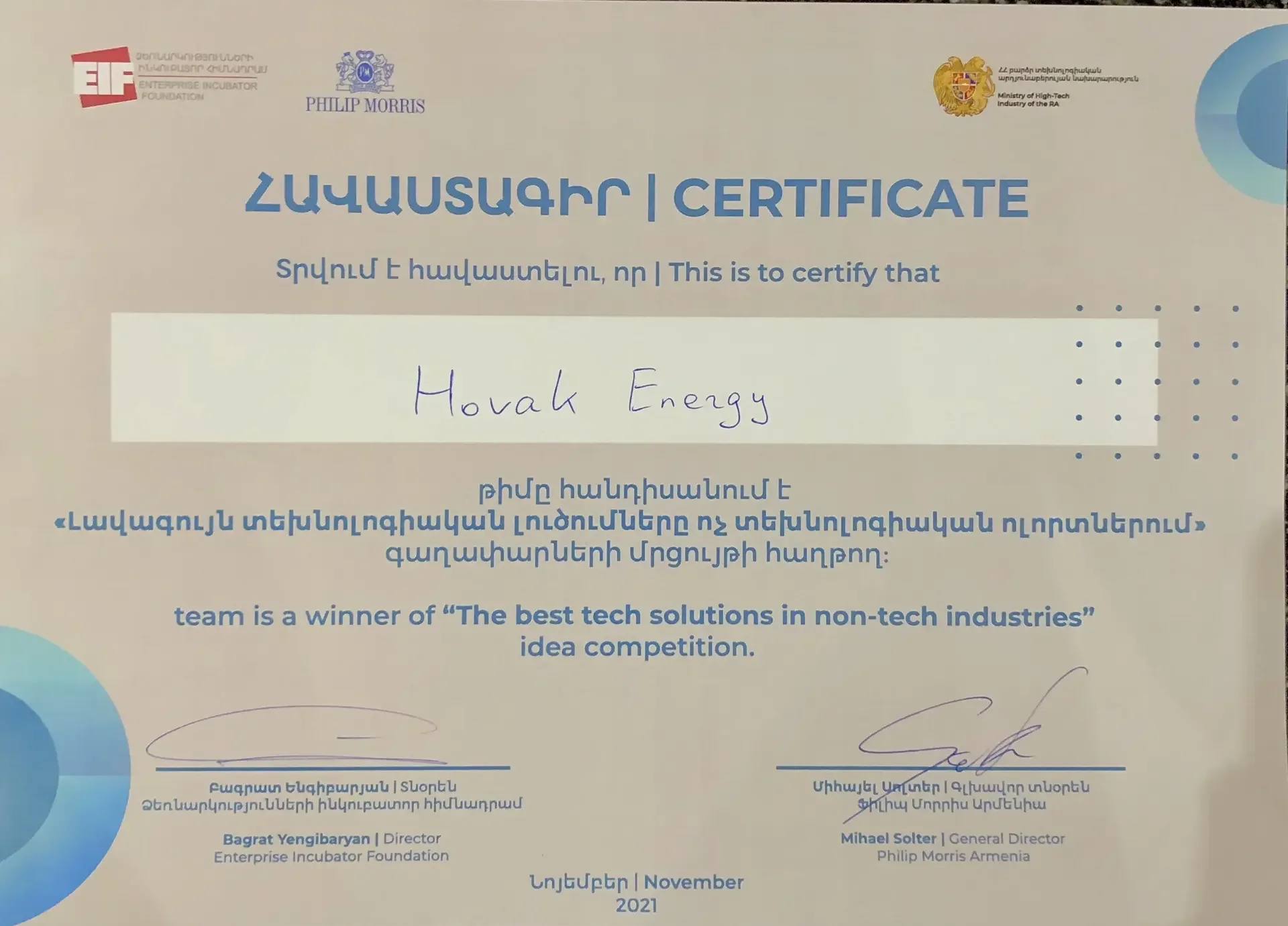
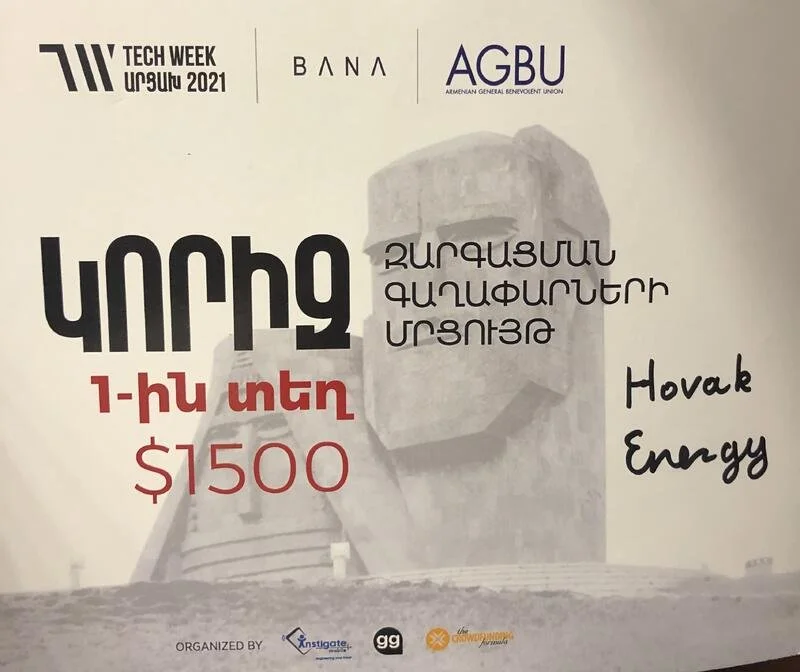
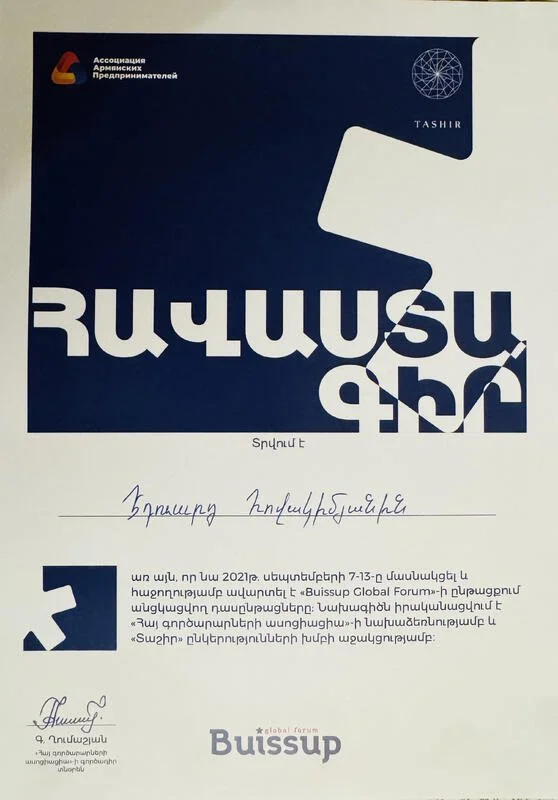
The Solar Compression Power Station is not a concept imported from a catalogue. It is the engineering legacy of its inventor, Vardan Hovakimyan, whose original design and calculations the HOVAK team continues to develop today — a body of work now spanning more than a decade. Along the way, the project has earned independent recognition, including Best Tech Solutions (EIF, Philip Morris, and the RA Ministry of High-Tech Industry, 2021), the Buissup Global Forum award (TASHIR, Armenian Businessmen Association, 2021), and the Koriz Development Ideas Competition (Artsakh Tech Week, BANA, AGBU, 2021).
Governance, Validation, and Delivery Discipline
HOVAK Energy is developed within a discipline framework oriented to institutional accountability:
phased technical validation,
documented engineering assumptions,
milestone-gated execution,
transparent reporting architecture,
and risk-managed scale-up decisions.
Key risk domains are addressed through standard infrastructure controls: site suitability, permitting timelines, procurement readiness, commissioning quality, operating protocol design, and maintenance planning.
The objective is not merely to demonstrate that the concept works, but to create a repeatable pathway from pilot to investable infrastructure.
Current Position and Near-Term Priorities
At the current stage, HOVAK Energy is focused on:
advancing site-specific engineering readiness,
finalizing pilot configuration frameworks,
expanding institutional and technical partnerships,
and preparing execution packages for grant, blended, and private-capital pathways.
The project remains power-first in public positioning. Water-related integration potential exists within the broader architecture, but is being communicated separately, and in appropriate depth, at a later stage.
Partnership Invitation
HOVAK Energy welcomes collaboration with:
national and regional authorities,
development agencies and climate funds,
engineering and EPC partners,
infrastructure investors and strategic industrial groups.
We are particularly interested in partnerships for pilot deployment, validation frameworks, co-development structures, and scale-oriented financing design. And we are just as glad to hear from communities, local residents, and individuals in the regions where this technology could one day operate — every partnership above began with someone simply taking an interest.
What We Are Seeking Now
We are currently seeking aligned partners for:
Pilot Site Collaboration — terrain-suitable host locations with data access and local coordination support.
Technical Partnership — engineering, metering, commissioning, and operational planning expertise.
Funding Partnership — grant, blended-finance, or strategic capital structures aligned with staged deployment.
Institutional Cooperation — regulatory, public-infrastructure, and resilience-program integration pathways.
Positioning Statement
HOVAK Energy is building a long-horizon renewable infrastructure platform designed for practical deployment, institutional reliability, and strategic energy resilience. Our approach combines physical simplicity, engineering discipline, and phased scalability — turning renewable potential into durable, inheritable infrastructure value.
HOVAK Energy — engineered for independence, designed for scale.
HOVAK Energy — FAQ
1) What is HOVAK Energy?
HOVAK Energy is a renewable infrastructure initiative developing the Solar Compression Power Station — a terrain-adapted solar-thermal system designed for long-life electricity generation in regions with energy vulnerability.
2) What problem does HOVAK Energy solve?
Many regions face expensive imports, unstable supply, and climate pressure on legacy grids. HOVAK Energy is designed to improve energy independence, resilience, and long-term affordability — in plain terms: power that is local, durable, and predictable in price.
3) How does the technology work at a high level?
The sun heats air inside a dark channel laid along a mountain slope; a controlled pressure-gradient section accelerates that heated airflow; and industrial generation components convert it into electricity. The slope provides the height that classical solar-chimney designs had to build at enormous cost.
4) Do you disclose full technical details publicly?
No. Public materials describe system logic and impact metrics. Proprietary design parameters, optimization methods, and site-specific configurations are disclosed only in controlled due-diligence formats (e.g., NDA).
5) Is the project patented?
Yes, with an evolving scope. The station’s original mechanism was protected by an Armenian patent and pursued internationally through filings that included a WIPO PCT application; as happens with technology developed over more than a decade, those early-stage filings have since completed their term or lapsed. The platform has grown since then — its newer engineering elements, including its water-integration architecture, represent fresh, unclaimed intellectual property, and securing dedicated protection for this next generation of the technology is a current strategic priority.
6) What is the current development stage?
The project is at an advanced pre-commercial stage with engineering validation work and pilot-oriented preparation. Reference TRL used in grant materials: TRL 6 (prototype demonstration in relevant conditions).
7) What economics can be shared publicly?
Current project benchmarks (preliminary, model-based, site-dependent) indicate:
Installed capacity cost: USD 300–600 per kW
Modeled payback range: 1–6 years
Design life target: up to ~100 years
These values are validated per site during pilot and engineering stages.
8) Why are these numbers shown as ranges?
Because real performance depends on terrain, climate, permitting, grid connection, civil works, materials, and final engineering configuration. We prefer credible ranges over inflated universal claims.
9) What geography is required?
The concept is designed for mountain-slope deployment, with suitability improving under favorable elevation and solar conditions. Final viability is determined through site screening and modeling.
10) Can the system be deployed in phases?
Yes. The architecture supports staged implementation, including early commissioning logic where technically and regulatorily feasible. This helps reduce financing pressure and execution risk.
11) What is the expected construction timeline?
Reference documentation indicates a potential construction horizon around ~1 year for defined configurations, subject to scope, permitting, logistics, and site conditions.
12) Is this only for grid-scale use?
No. The platform can be adapted for multiple scenarios: regional infrastructure, industrial power support, and remote-area resilience applications, depending on site and project size.
13) What environmental impact is expected?
The station burns nothing and consumes no fuel: its energy source is sunlight on a mountainside. Internal impact modeling used in grant contexts includes significant CO₂ reduction potential (site/configuration dependent), alongside minimal land competition — the system occupies slopes rather than farmland.
14) Are water capabilities part of the project?
Yes, water-related modules are part of the broader roadmap, but the current public positioning is power-first. A dedicated water section will be published separately.
15) How is risk managed?
Risk is managed through milestone-based execution:
site qualification,
pilot engineering and validation,
staged build-out,
scale-up after performance confirmation.
16) What kind of partners are you looking for now?
We are open to:
pilot-site hosts,
engineering and EPC partners,
grant and blended-finance institutions,
strategic infrastructure investors.
17) What can partners receive in due diligence?
Under appropriate confidentiality structure, partners can access technical briefs, engineering assumptions, milestone plans, validation logic, and deployment frameworks.
18) What is your core mission in one sentence?
To build bankable, resilient, long-life renewable infrastructure that helps regions move from energy dependence to practical energy sovereignty.